Yormark plans to exit early after reshaping the Big 12 through expansion and new commercial deals, while questions remain over some of his revenue initiatives.
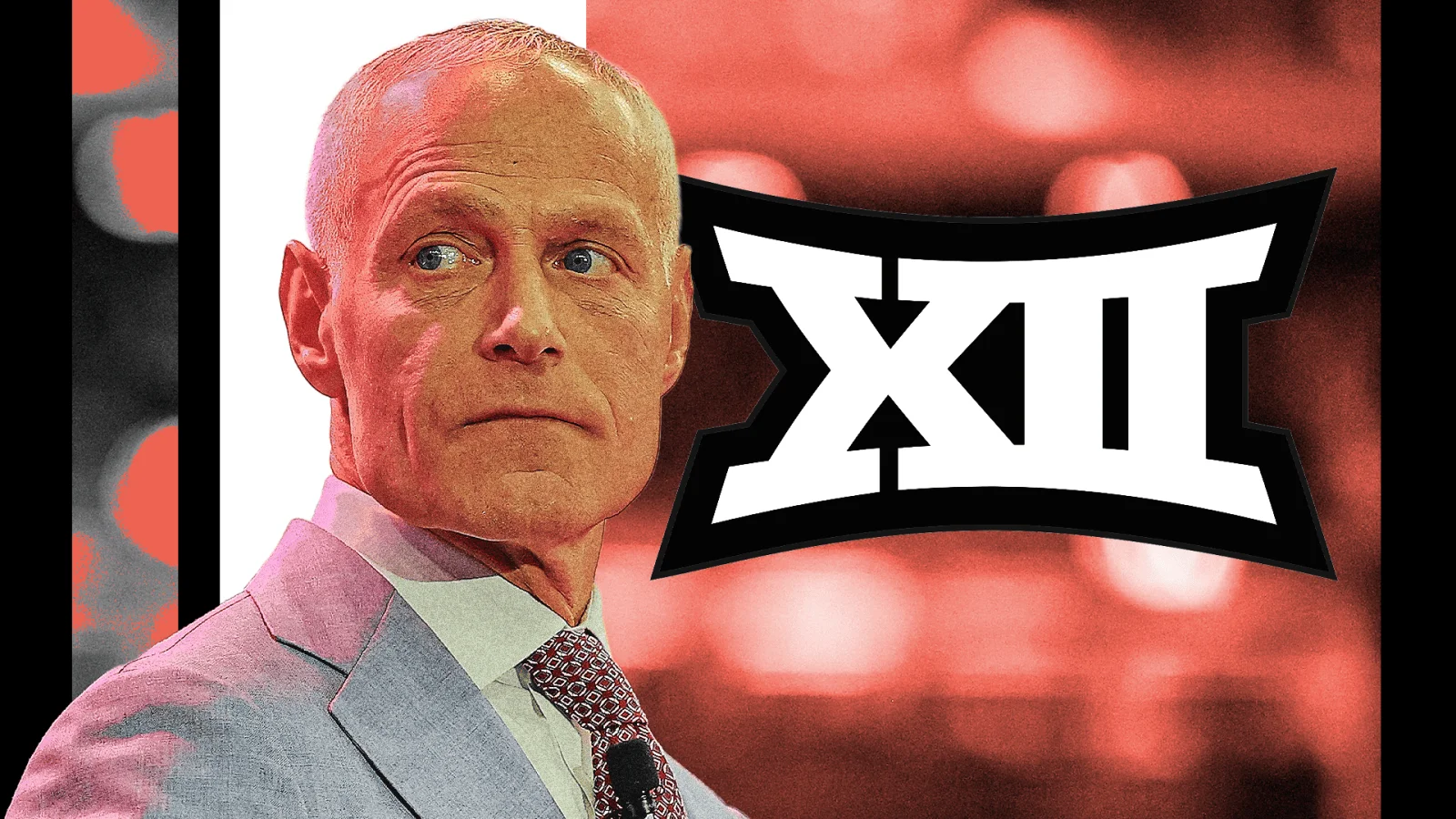
A consequential run at the Big 12
Brett Yormark will leave the Big 12 in early 2027, departing roughly three years before his contract expires. His exit closes a short, consequential run in which the conference stabilized its membership and expanded its commercial ambitions, though some of those efforts have drawn questions about their value. The timing gives the league a head start on a leadership change, but it also leaves an obvious question: how much of Yormark’s strategy will survive him?
Yormark announced his plan on Friday, saying he had met his goal of putting the conference on “an upward trajectory.” The Big 12 said it would begin searching for a successor immediately. That search will test whether the conference wants continuity in its commercial approach or a leader who reassesses which bets are producing tangible returns.
A fast response to conference upheaval
When the Big 12 hired Brett Yormark in August 2022, Texas and Oklahoma were preparing to leave. Their planned departures threatened to alter the conference’s standing and bargaining position. Yormark moved quickly to strengthen the league’s position, negotiating a new television agreement before the Pac-12 and then bringing Arizona, Arizona State, Colorado and Utah into the conference.
Those moves addressed two connected pressures: the loss of prominent members and the need to present broadcasters and schools with a viable conference structure. Expansion helped preserve a broad membership base, while completing a television agreement ahead of the Pac-12 gave the Big 12 a clearer near-term footing. It’s a practical achievement, even if the long-term value of a larger conference depends on what its members can generate together.
His appointment also reflected a wider turn toward executives with experience outside college sports. The industry was confronting rapid commercial change, particularly in football and basketball, and Yormark arrived with a reputation for salesmanship and a willingness to pursue new business models. Other leaders recruited from beyond college athletics in recent years include former Pac-12 chief George Kliavkoff, Big Ten commissioner Tony Petitti and NCAA president Charlie Baker.
The appeal of that background is clear: commercial experience can help an organization find new partners and tell a sharper story to potential buyers. But college conferences are not conventional media or entertainment businesses. They have to balance institutional priorities, member interests and the uneven economics of their sports. A persuasive pitch matters. So does proving the deal works for the schools involved.
Commercial bets draw scrutiny
Yormark was among college sports’ most vocal advocates for private equity. Earlier this year, the Big 12 partnered with a private equity firm to establish a credit facility that member schools could use. Sportico reported that it was unaware of any school drawing on the funds. That leaves the facility’s practical impact difficult to assess from public information: its existence signals an appetite for new financing structures, while reported use would show whether schools see a reason to take them up.
Credit can give institutions another option when they need capital, but the availability of a facility isn’t the same as demand for it. (And this is the part most people overlook.) A financial arrangement can attract attention when it’s announced and still matter little to members if they don’t use it. For now, the Big 12’s private equity experiment remains more notable for its potential than for any publicly reported result.
The conference also signed a league-wide naming rights, jersey patch and advertising agreement with Monster Energy in July. The deal was reportedly worth $20 million a year, a figure some industry observers considered low: Ohio State and Notre Dame each receive about that amount for their individual jersey patch agreements. That comparison isn’t a direct measure of the conference deal’s value, since one agreement covers a league-wide package and the others concern individual schools. Still, it helps explain why the reported figure prompted questions.
League-wide sponsorships offer a way to sell access and visibility across multiple programs under one arrangement. Their value depends on the audiences, inventory and rights included, details that aren’t established by the reported annual figure alone. The comparison with Ohio State and Notre Dame is striking, but it also underlines how much the economics of a conference package can differ from those of high-profile individual schools.
That gap captures the mixed assessment of Yormark’s commercial push. He consistently pursued new revenue sources, but the returns from at least some headline deals have been questioned. The conference’s private equity facility, meanwhile, has yet to show publicly reported use by a member school. The numbers here are underwhelming beside the individual patch agreements, though the available information doesn’t settle what the full package is worth to the Big 12.
An early departure despite an extension
In May 2025, the Big 12 board voted to extend Yormark’s contract through the 2029-30 academic year. Board chair and Baylor president Linda Livingstone praised his work at the time: “Brett’s strategic thinking and creative initiatives have been vital to the Big 12’s success, and we look forward to building on this momentum in the years ahead.” The extension offered a public endorsement of his direction, yet his planned departure means the board’s stated horizon and his personal timetable no longer align.
Still, the extension did not settle questions about how long Yormark would stay. Before it was approved, he interviewed for a CEO role with the new owners of the Minnesota Timberwolves and Lynx. The position went to Matthew Caldwell. ESPN has reported that Yormark expects his next job to be outside intercollegiate athletics. That history gives his departure some context, but it doesn’t establish what role he’ll pursue next.
His exit also puts the board’s earlier extension in a different light. Contracts can signal confidence and provide continuity, but they can’t guarantee that a leader will remain through the full term. The Big 12 now has to plan for a handoff while keeping its members aligned on what the conference should prioritize.
What the next commissioner inherits
The Big 12 will now need to find a leader to carry its expanded footprint and commercial strategy into the next phase. Yormark’s record leaves a clear starting point: the conference is more settled after losing its two biggest members, while the value of its newer revenue experiments remains an open measure of his tenure. That’s a real accomplishment, with an unfinished business list.
For the successor, the task won’t be simply to repeat Yormark’s pace of dealmaking. The league will need to judge whether its partnerships produce value members can recognize, whether its financing options serve a practical need, and how best to present its expanded membership. Those questions are familiar in conference management, where a deal’s headline terms may tell only part of the story.
If you’re working in this space, the central lesson is that commercial ambition earns attention quickly, while results take longer to establish. Yormark leaves with the Big 12 on firmer ground than it faced at his arrival, but the record on some of his most discussed initiatives is still incomplete. The next commissioner inherits both the platform and the burden of showing what it can deliver.
Discussion
Sign in to join the discussion.